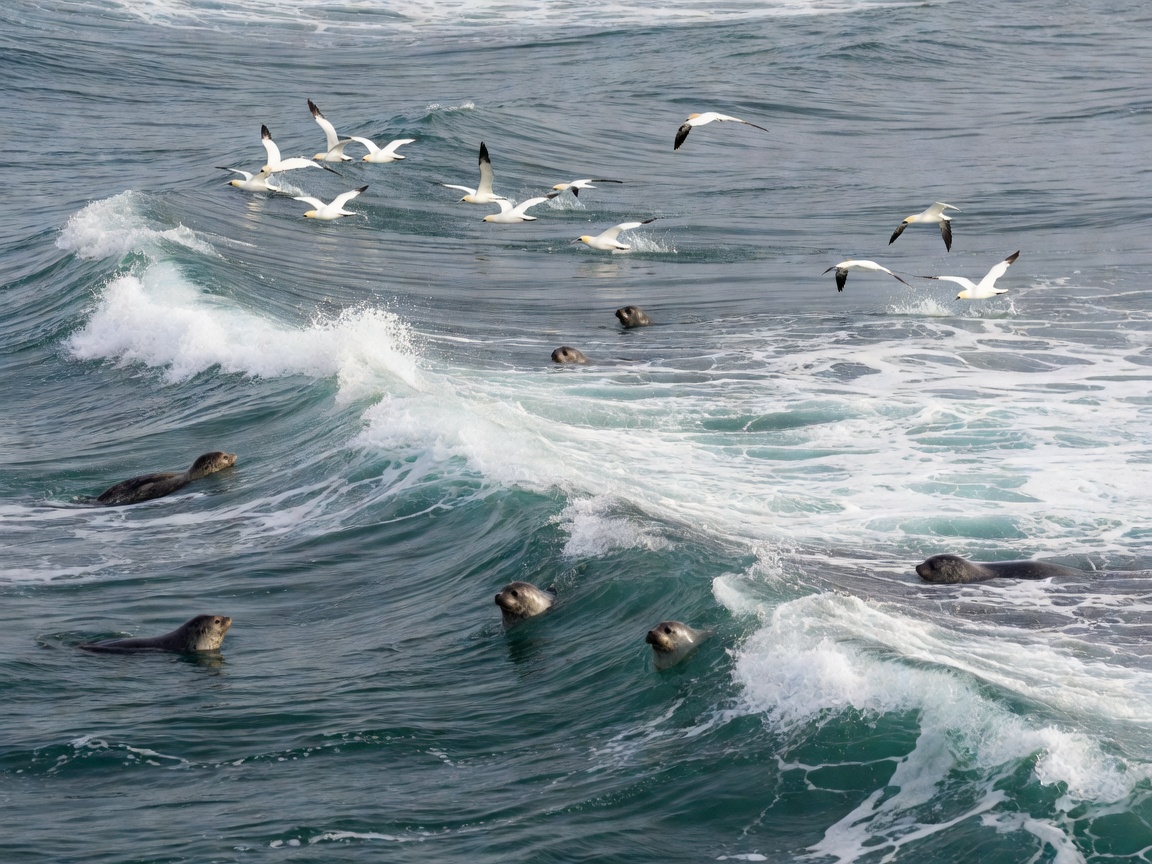
1. Multi-Species Feeding Associations
In the open North Atlantic, seabirds and marine mammals operate as interconnected forage partners. Whales, porpoises, and large predatory fish drive shoals of herring, sand eels, and sprat toward the ocean surface from below, creating concentrated "bait balls".
Seabirds exploit this action from above. Northern Gannets spot bait balls from heights of 25 to 30 metres, plunging vertically at speeds exceeding 90 km/h. Beneath them, Common Guillemots and Razorbills execute deep pursuit dives to trap the school, while surface-feeding kittiwakes and petrels gather at the perimeter to glean stunned fish fragments.
2. Shore-Based Cetacean & Pinniped Viewing
Observers do not need boat vessels to monitor marine mammals. Elevated coastal cliffs provide panoramic vantages across nearshore waters without producing underwater acoustic disturbance.
- Harbour Porpoise (Phocoena phocoena): Found in sheltered tidal sounds, narrow firths, and shallow bays. Watch for small, blunt triangular dorsal fins rolling smoothly in calm sea states (Beaufort 0 to 2).
- Minke Whale (Balaenoptera acutorostrata): Regularly seen off headlands during late summer. Look for a sickle-shaped dorsal fin appearing simultaneously with a low, inconspicuous blow 20 to 40 seconds before submerging.
- Grey Seal & Harbour Seal: Haul-outs on offshore rocky skerries and remote shingle coves. Maintain spotting scope observation from high cliff plateaus; seals flush quickly if humans appear on the shoreline below.
- Killer Whale (Orcinus orca): Regional pods track seals and seasonal herring movements along the coastlines of Shetland, Orkney, and western Iceland. Characterised by tall, erect male dorsal fins up to 1.8 metres high.
3. Ethical Boat-Based Viewing Standards
When viewing pelagic wildlife from boat vessels, strict navigational conduct is essential to prevent injury and acoustic harassment:
- Maintain Speed Thresholds: Vessels must operate at no-wake speed (under 5 knots) when within 300 metres of any marine mammal or floating seabird raft.
- Parallel Course: Never head directly toward an animal or cut across its travel path. Move on a parallel, predictable heading at a steady throttle.
- No Splitting of Pods: Do not navigate between mother-calf pairs or divide dispersed social pods of whales or dolphins.
- Seabird Rafts on Water: Molting alcids are flightless during late summer. Steer well clear of swimming flocks; forcing them to scatter drains critical energy stores.
4. Acoustic & Environmental Disturbance
Sound travels five times faster in water than in air. Abrupt throttle shifts, depth sounders, and cavitation cause severe stress to marine wildlife. Engines should be idled in neutral when drifting near feeding areas, and never switched on abruptly directly adjacent to surfacing animals.
Good For
Detecting pelagic fish schools through avian behavior, recording coordinated hunting between seabirds and cetaceans, and observing marine mammal social interaction from land.
What To Know
Cetacean sightings from shore require low swell and calm surface conditions (Beaufort Force 0–2). In whitecaps (Force 3+), small porpoises become virtually undetectable.